
Clay County Court Records After Arrest
An arrest in Clay County usually starts with booking at Clay County Detention Center. The court record begins when the prosecutor or court system creates a filed case. Those court records after a jail arrest can include the complaint, citation, indictment, information, docket entries, bond orders, warrant entries, charge amendments, dismissals, pleas, and sentencing records. They are not the same thing as the jail roster.
The Clay County Court of Justice page lists the Clay County Justice Center, Circuit Court Clerk Leslie Phillips, court hours, phone, fax, accessibility notes, and payment options. For custody or booking records, use Clay County jail inmate records. For booking photos, use the Clay County jail mugshots page. For filed charges, court dates, and case copies, use Kentucky Court of Justice systems or the clerk.
Arrest to Clay County Court Record
The court-record path follows a local sequence. A sheriff deputy, Manchester officer, Kentucky State Police trooper, or another authorized agency makes the arrest. The person is booked at the jail. The charging agency and prosecutor then move the case toward District Court or Circuit Court. District Court handles misdemeanors, violations, traffic matters, arraignments, and felony probable-cause hearings. Circuit Court handles felonies and capital offenses.
- Arrest and booking create the jail custody record.
- The prosecutor reviews the allegations and charging path.
- The court record opens through a complaint, citation, information, or indictment.
- The docket shows hearings, bond actions, warrants, and status changes.
- The clerk is the correct office for copies of filed court records.
Find Clay County Court Records
The Kentucky Court of Justice docket search is the public starting point for scheduled court appearances. The research captured fields for division, date, county, courtroom, and subdivision. Select Clay County and choose District or Circuit based on the type of matter. The docket search is best for upcoming or scheduled proceedings, not for a full background report.
| Field label | Type | Required | Notes |
|---|---|---|---|
| Division | Dropdown/radio | Yes | Choose Circuit or District. |
| Date | Date | Yes | Search by court date. |
| County | Dropdown | Yes | Select Clay. |
| Courtroom | Dropdown | Optional/default | ALL option visible. |
| Subdivision | Dropdown | Optional/default | ALL option visible. |
| Submit | Button | n/a | Runs the docket search. |
The KYeCourts guest login is the official Find a Case entry point. The exact in-portal Clay field inventory was not fully captured, but public descriptions point to case-number, party-name, business-name, or citation search. The guest portal requires accepting its terms before using detailed case search functions.
Clay County Court Search Screens
The image manifest includes a successful capture of the Clay County Court of Justice page, which is the local clerk and courthouse reference for court records after a jail arrest.
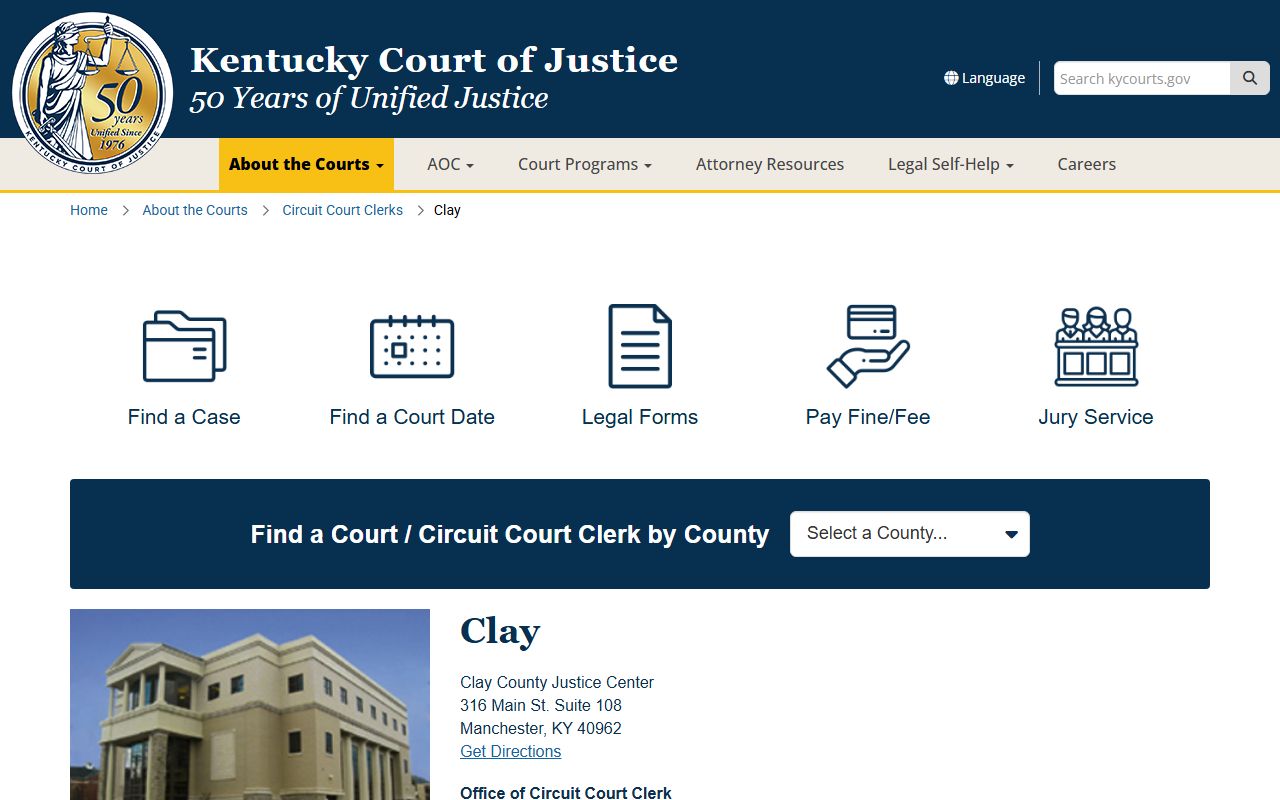
Use that county court page for local clerk details, then use the statewide court portals for docket and case lookup.
The Kentucky court docket search capture shows the official docket interface used for Clay County court dates.
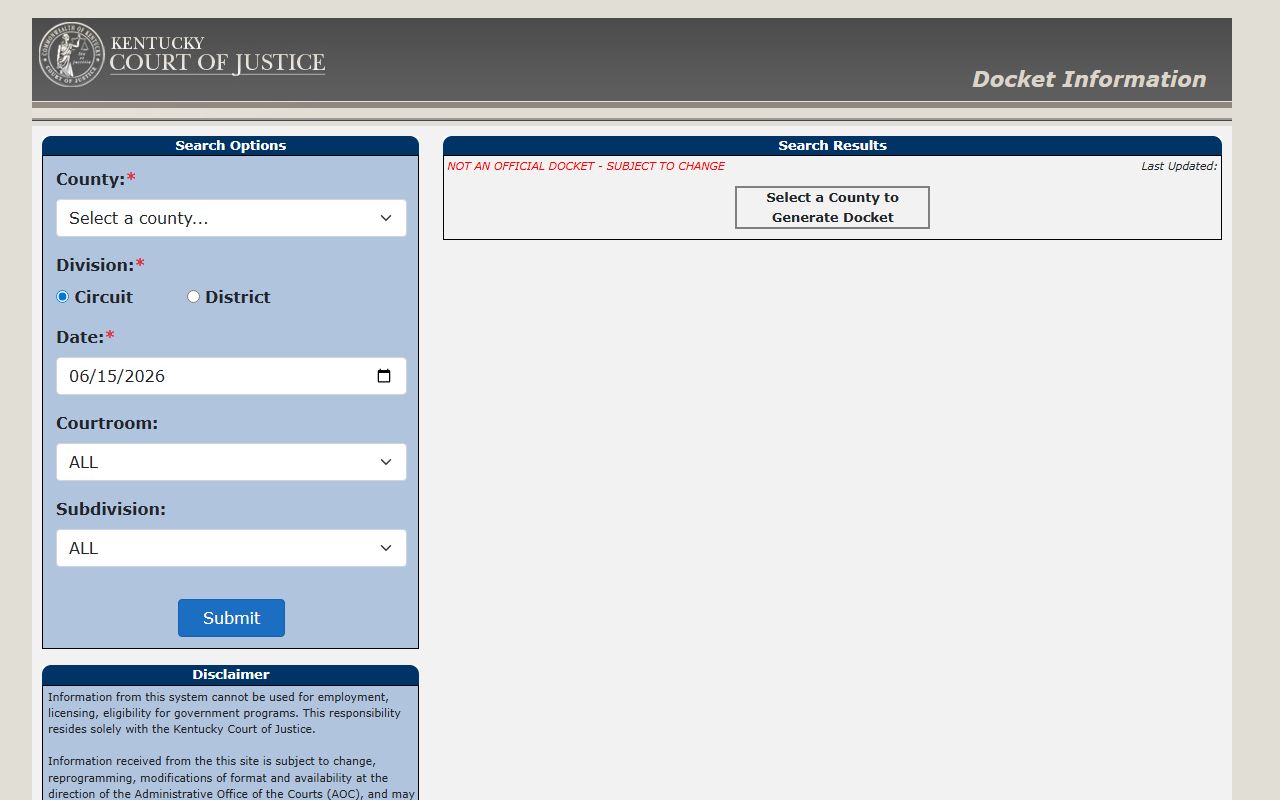
The docket tool is most useful when the case has a hearing date or the user knows which division to search.
Charging Documents After Arrest
Court records after a Clay County arrest are built from formal charging documents. The exact document depends on the charge level and case route. A booking charge can change after the prosecutor reviews the facts, so do not treat the jail roster as the final charge list.
| Document | Typical role | Where it fits |
|---|---|---|
| Complaint or citation | Starts many criminal cases or traffic matters | Often begins in District Court. |
| Information | Formal prosecutor filing in qualifying cases | Can move a felony case into Circuit Court. |
| Indictment | Grand jury charging document | Common in felony prosecution. |
Clay County Charge Status
Charge status can shift through the court record. A charge can be pending, amended, reduced, dismissed, or resolved by plea or verdict. A court record after an arrest is still not a conviction unless the court enters a guilty plea, guilty verdict, or other conviction disposition.
| Status | Meaning |
|---|---|
| Pending | The charge or case has not reached final disposition. |
| Amended or reduced | The prosecutor or court changed the original charge. |
| Dismissed | The charge ended without a conviction on that charge. |
| Acquittal | The person was found not guilty. |
| Conviction | The court entered a guilty plea, guilty verdict, or qualifying disposition. |
Bond and Warrants After Arrest
Bond may be set by a judge or court officer through the first-appearance process, by warrant terms, or through a later court order. Clay County did not publish a detailed jail bond FAQ. Call the jail or clerk before traveling, and ask whether the bond is cash, surety, PR, no-bond, or blocked by a detainer. A bond on one case may not release a person if another hold is active.
No official Clay County active-warrant search page was located. For warrant questions, use the Clay County Sheriff, the Clay Circuit Court Clerk, Manchester Police for city matters, KCOJ docket search for scheduled cases, and KYeCourts for filed case records. People who believe they have an active warrant should speak with counsel or the issuing court before appearing because a warrant can lead to arrest.
| Bond type | How it works |
|---|---|
| Cash bond | Money is paid directly under court rules. |
| Surety bond | A licensed bail agent guarantees appearance for a fee or collateral. |
| Personal recognizance | Release based on a promise to appear, often with conditions. |
| No-bond hold | Custody continues until the court changes the order or the hold clears. |
Charges vs Convictions
Clay County court records after a jail arrest can show accusations before any conviction exists. This matters for readers, employers, landlords, and family members trying to understand what a record means. A charge is an allegation in a court case. A conviction is a final legal result after a plea, verdict, or qualifying disposition.
| Issue | Charge | Conviction |
|---|---|---|
| Stage | Filed accusation | Final guilty result or qualifying plea |
| Proof | Based on probable cause or charging decision | Requires plea, verdict, or court disposition |
| Can change? | Yes, charges may be amended or dismissed | Can be appealed, vacated, or expunged only through legal process |
Sealed and Expunged Records
Kentucky open-records law does not make every criminal case detail public forever. Juvenile records, sealed records, expunged records, some investigative records, and private information can be restricted. KSP identifies KRS 431.073 as Kentucky's felony expungement statute, and court expungement rules should be followed through the Kentucky Court of Justice process.
| Term | Plain meaning | Practical effect |
|---|---|---|
| Sealed | Public access is limited | Some agencies may retain limited access. |
| Expunged | Eligible record is cleared through legal process | Public search access can be removed or restricted. |
| Dismissed | A charge ended without conviction | It may still appear until expungement or record correction is completed. |
Clay County Background Reports
The AOC criminal-record report page describes statewide CourtNet reports. The research found that reports include misdemeanor and traffic cases for at least the last five years and felonies dating back to 1978. Online payment accepts major credit or debit cards with a 2.25 percent fee or $2.50 minimum, and mail-service requests use check or money order payable to Kentucky State Treasurer.
For copies of court case records, the Kentucky Court of Justice record request page says requests start with the clerk of the court that heard the case. For Clay County, that means the Clay Circuit Court Clerk at the Justice Center. Records may be in the clerk's office, in a records facility, or destroyed under retention schedules.
Important: This site is not a consumer reporting agency and cannot be used for FCRA-covered screening decisions.
Clay County Prosecutor Contact
Kentucky uses county attorneys and commonwealth's attorneys rather than a district-attorney title. The Clay County Attorney page names Joseph White as Clay County Attorney. The county page lists the office at 102 Walters Street, Suite 2, Manchester, KY 40962, with phone (606) 598-5110 and fax (606) 598-5660. The separate county-attorney contact page lists office hours Monday through Friday, 8:00 AM to 4:30 PM.
For filed court records, use the clerk and court portals. For prosecution questions, contact the county attorney's office when the matter fits that office. For custody and release, contact the jail. These offices often touch the same arrest, but they do not maintain the same record.